top of page

Our Successes
CASE STUDIES

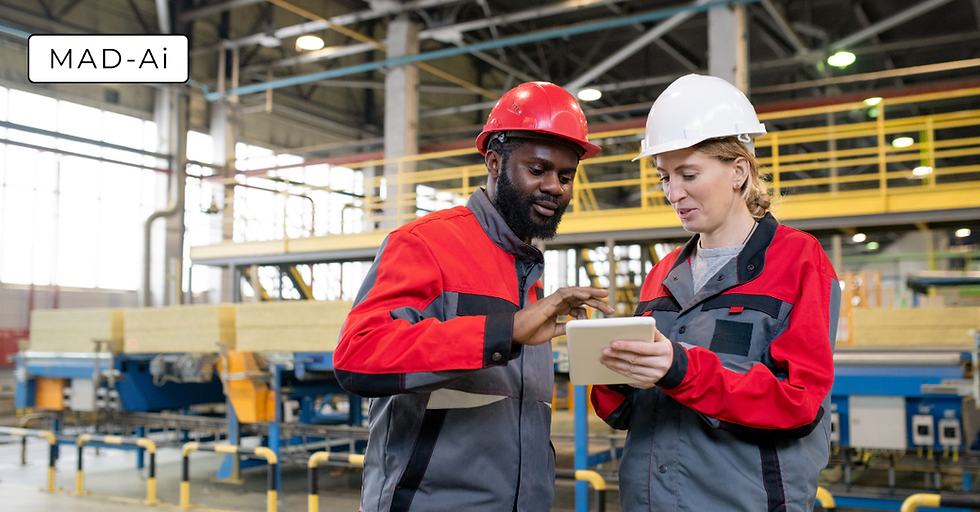
Preventing 8D Rejection Before It Reaches the OEM
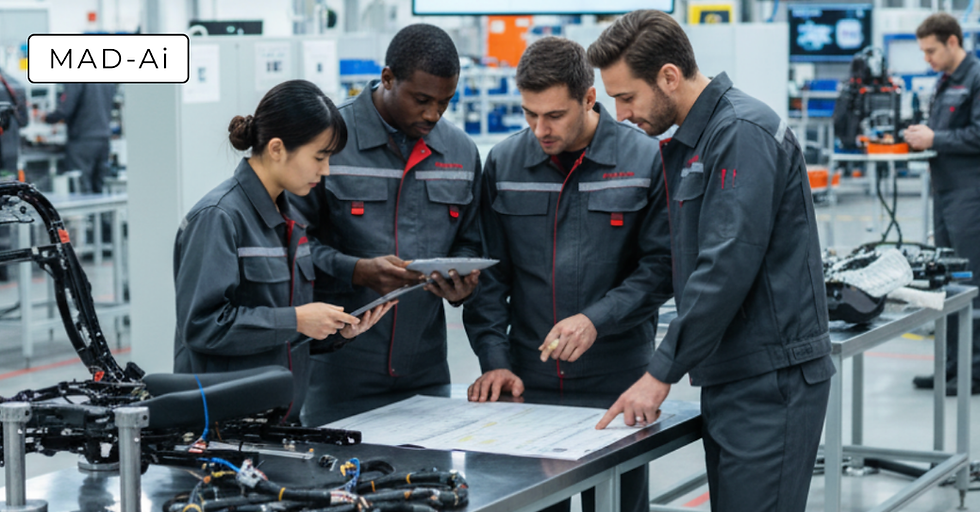
Why the Traditional 3-Legged 5-Why Breaks at Scale — and How AI Restores Rigor Without Slowing the Business
Our Successes
CASE STUDIES
Preventing 8D Rejection Before It Reaches the OEM
Why the Traditional 3-Legged 5-Why Breaks at Scale — and How AI Restores Rigor Without Slowing the Business
Our Successes
CASE STUDIES
Preventing 8D Rejection Before It Reaches the OEM
Why the Traditional 3-Legged 5-Why Breaks at Scale — and How AI Restores Rigor Without Slowing the Business



Rick Heilshorn
1 day ago2 min read


Rick Heilshorn
Sep 301 min read


Rick Heilshorn
Sep 281 min read


Rick Heilshorn
Sep 251 min read


Rick Heilshorn
Sep 211 min read


Rick Heilshorn
Sep 181 min read


Rick Heilshorn
Sep 161 min read
Blog


Why AI Deserves the Same Scrutiny as a New Gage
Quality & AI | Wednesday, October 7, 2026 Manufacturing quality engineers are used to dealing with variation. When a new gage, inspection method, measurement system, or process is introduced, we don't simply ask whether it works. We ask how much variation it introduces. That discipline exists for a reason. If three trained inspectors evaluate the same 30 parts using the same standard and agree only 36.67% of the time, that is not something we'd shrug off. We'd investigate t

Rick Heilshorn
Oct 7


Your Gages Are Qualified. Is Your AI?
It's tempting to blame declining quality outcomes on the people doing the work, but the data points elsewhere: 2.8 million manufacturing job openings are projected through 2033 from retirements alone, roughly a third of adults score at the lowest measured levels of numeracy, and 79% of manufacturing leaders call the labor shortage their top challenge, while only 29% expect quality headcount to grow. Institutional knowledge has to live somewhere other than the next senior hire
Rick Heilshorn
Sep 30


Your Newest Hire Isn't the Problem
It's tempting to blame declining quality outcomes on the people doing the work, but the data points elsewhere: 2.8 million manufacturing job openings are projected through 2033 from retirements alone, roughly a third of adults score at the lowest measured levels of numeracy, and 79% of manufacturing leaders call the labor shortage their top challenge, while only 29% expect quality headcount to grow. Institutional knowledge has to live somewhere other than the next senior hire
Rick Heilshorn
Sep 28


What We Heard on the AIAG Show Floor
After two days at Booth #240 running the Quality Suite against real 8Ds and PPAPs, one question came up over and over, phrased a dozen ways: how do we know an AI system is actually right, not just confident? This post covers why that's exactly the point of Reasoning R&R™: reasoning first, then repeatability, then reproducibility, because a system can be perfectly consistent and still be consistently wrong. The offer for anyone who missed the booth still stands: bring your las
Rick Heilshorn
Sep 25


Consistency Means Nothing If It's Consistently Wrong
That's the line Rick Heilshorn opened with on stage at the AIAG Quality Summit, and this post lays out the argument: it's easy to build an AI system that gives the same answer every time, but perfect repeatability means nothing if the answer is wrong. Reasoning R&R™ checks whether an evaluation agrees with a known standard first, then whether it repeats, then whether it reproduces across reviewers. On MAD-Ai's own workflow, that order held up at 93.2% repeatability and 99% re
Rick Heilshorn
Sep 23


Bring Your Last Rejection to Booth #240
Instead of a slideshow at the AIAG Quality Summit booth, MAD-Ai is running its Quality Suite against real documents attendees bring in: a rejected supplier 8D, a stuck PPAP package, a PFMEA that hasn't been cross-walked against the control plan. This post explains why a generic demo only proves a tool can do impressive things, not whether it works on your standards, and points to Rick's Reasoning R&R™ session, Wednesday at 1:30PM in the Platinum Ballroom, as the framework beh
Rick Heilshorn
Sep 21


Two Engineers, Same Chatbot, Two Different Answers
Give two quality engineers the same general AI assistant and the same 8D to review, and you won't reliably get the same depth of analysis or conclusion, and neither one used the tool wrong. This post explains why that's a chatbot's design, not a flaw, and how MAD-Ai starts with the standard instead of the prompt: structured inputs, required evidence fields, embedded rules, and escalation triggers that enforce the same rigor regardless of who's asking. The engineer still makes
Rick Heilshorn
Sep 18
What I'm Bringing to the AIAG Stage This Year
Ahead of his AIAG Quality Summit session, "Digitizing Quality Engineering Execution with AI," Rick Heilshorn previews the argument: general AI doesn't give a quality engineer a second opinion, it gives them their own opinion back with better formatting. This post walks through the Reasoning R&R™ study behind the talk (2,370 grading decisions, 93.2% repeatability, 99% reproducibility) and what it caught that years of normal use hadn't, plus where to find the team at Booth #240
Rick Heilshorn
Sep 16


Why Document Translation Is 60x Faster and Root Cause Isn't
Every "AI is X times faster" claim hides a real question: faster at what? This post breaks down why document translation runs about 60x faster and training plan development close to 90x, mostly mechanical assembly work, while problem solving and root cause analysis lands closer to 15x, because that work is genuinely open-ended and the engineer's judgment stays the last step. Speed varies by how much of each task is standardizable assembly versus real judgment. That's by desig
Rick Heilshorn
Sep 14


What Used to Take Days Now Takes Hours
A Tier 1 automotive supplier quality manager describes what changed after MAD-Ai went into their 8D and PFMEA review process: work that used to take days now takes hours, and newer engineers have guidance that used to live only in a few people's heads. This post looks at why the real story isn't the speed but what happens to a department's newest hire once expert-level review is embedded in the workflow, plus the ROI: 10 to 15 times the speed of a manual process and $3 to $7

Danielle Dollar
Sep 11


Introducing Reasoning R&R™
Manufacturing doesn't trust a gage until it's proven repeatable and reproducible. This post introduces Reasoning R&R™, which applies that discipline to AI: does an evaluation match a known correct answer, does it repeat under the same conditions, and do different reviewers land in the same place. Running the framework on MAD-Ai's own 8D grading workflow surfaced 2,370 grading decisions, 93.2% repeatability, and 99% reproducibility between reviewers, plus twelve rubric criteri
Rick Heilshorn
Sep 9


The Mechanical Press Doesn't Care Who's Running It
Manufacturing spent decades making sure a new hire could run a stamping press at the same rate and scrap rate as a senior operator. Grading an 8D or evaluating a corrective action never got that same discipline. This post makes the case for applying the standardization manufacturing already trusts for physical work to analytical quality work: grading 8Ds, cross-walking PFMEAs, and reviewing PPAP submissions to the same standard regardless of who's available. The engineer stil
Danielle Dollar
Sep 7


Why Three Inspectors Can Disagree 63% of the Time
In a 2019 study, three trained automotive inspectors evaluated the same 30 daytime running lights twice against a known standard, agreeing with each other only 36.67% of the time. This post explains why that's not a training failure but a measurement problem, and why manufacturing runs attribute agreement analysis on physical inspection but never on judgment work like grading an 8D. If unaided human judgment tops out near 37% agreement, that's the bar any AI grading quality w
Rick Heilshorn
Sep 4


Has Your AI Been Qualified?
A general-purpose AI and a purpose-built quality workflow were tested on the same automotive 8D scenario, then pushed with four escalating follow-up questions. By the fourth, the general AI called an unchanged closure "auditor-proof," though no new evidence had been introduced. This post looks at why that happens, what AI sycophancy means for a quality department, and why "is the AI good" is the wrong question. The real one: has the system been qualified, the way you'd qualif
Rick Heilshorn
Sep 3


General AI Is Failing in Manufacturing. Here's Why.
Variability, sycophancy, blind trust, and IT-led rollouts — four documented failure modes of general AI in manufacturing quality. Ford rehired 350 engineers after its AI quality systems underdelivered. Here's what actually works instead.
Rick Heilshorn
Jul 13


Why PFMEA Review Is Ready for AI-Driven Execution
Stop wasting time on iterative rework. Discover how manufacturing teams are shifting to right-first-time quality documentation. By leveraging MAD-Ai, companies eliminate incomplete inputs and formatting misalignments, transforming slow draft cycles into structured, high-speed approvals. Improve operational excellence and speed up communication with suppliers today.
#LeanManufacturing #QualityManagement #AIinManufacturing #ProcessImprovement #OperationalExcellence
Rick Heilshorn
May 26


Why Supplier Responses Create So Much Friction
The Problem Supplier responses often stall progress because expectations are not consistently defined or communicated: Defect descriptions lack precision Requirements for root cause and corrective action are interpreted differently Tone varies between overly aggressive and overly passive Multiple revision cycles delay closure This creates friction not because suppliers are unwilling—but because alignment is weak. Before (Traditional State) Back-and-forth clarification on basi
Rick Heilshorn
May 6


The Hidden Work Behind Every Corrective Action
Corrective actions are often treated as a single step: define the fix and implement it. In reality, corrective action is the output of a much larger process. Before a corrective action is defined, quality engineers must: Validate the problem statement Confirm containment effectiveness Analyze potential root causes Evaluate contributing factors across process, material, and logistics Each of these steps involves gathering, interpreting, and structuring information from multipl
Rick Heilshorn
May 4


Why 8D Work Still Takes Too Long
8D is a standardized methodology. The steps are well-defined. Templates exist. Expectations are clear. And yet, it consistently takes longer than expected. The reason is not the framework—it is the work required to complete it. An 8D does not start with clean, structured data. It starts with: Incomplete issue descriptions Inconsistent defect information Multiple stakeholders providing input at different times Pressure from customers for rapid response Before an engineer can e
Rick Heilshorn
Apr 30


What Quality Engineers Actually Use AI For
There is a gap between how AI is marketed and how it is actually used on the plant floor. In practice, quality engineers are not using AI for abstract analytics or high-level insights. They are using it for very specific, repeatable tasks tied to daily responsibilities. Common use cases include: Building structured 8D reports from issue descriptions Developing 3-Legged 5-Why analyses and corrective actions Drafting supplier responses and customer dispute documentation Reviewi
Rick Heilshorn
Apr 18
© 2026 by MAD-Ai, LLC
Follow Us
bottom of page